
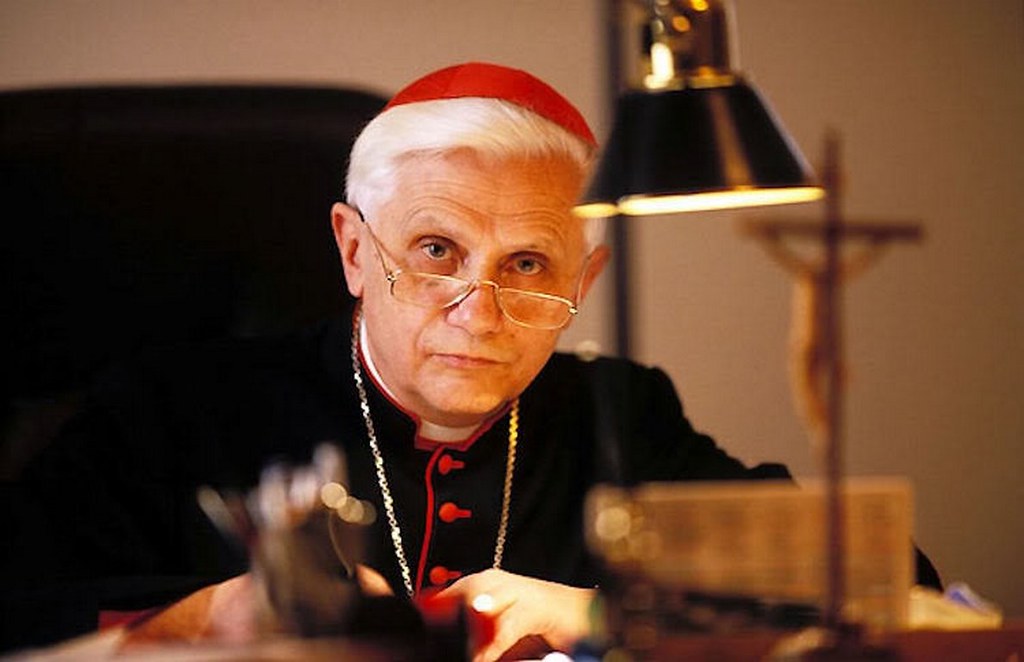
The following is an excerpt from Chapter 1 of Values in a Time of Upheaval by Cardinal Ratzinger. The book is a wonderful read and although out of print it can be found on Amazon and Abe Books.
Politicians of all parties take it for granted today that they must promise changes – naturally, changes for the better. The once mythical radiance of the word “revolution” has faded in our days, but far-reaching reforms are demanded and promised all the more insistently. This must surely mean that there exists in modern society a deep and prevailing sense of dissatisfaction precisely in those places where prosperity and freedom have attained hitherto unknown heights. The world is experienced as hard to bear. It must become better. And it seems that the task of politics is to bring this about. So since the general consensus is that the essential tasks of politics is to improve the world, indeed to usher in a new world, it is easy to understand why the word “conservative” has become disreputable and we scarcely anyone views lightly the prospect of being called conservative, for it appears that what we must do is not preserve the status quo but overcome it.
TWO VISIONS OF THE POLITICAL TASK:
THE TRANSFORMATION OF THE WORLD OR THE PRESERVATION OF ITS ORDER
This fundamental orientation in the modern conception of politics (indeed, of life in general) is in clear in contrast to the views of earlier periods, which considered the great task of political activity to be precisely the preservation and defense of the existing order, warding off threats against it. Here, a small linguistic observation May shed light on this matter.
When Christians in the Roman world were looking for a word that could express succinctly and comprehensively what Jesus Christ meant to them, they discounted the phrase conservator mundi (“conserver of the world”), used in Rome to indicate the essential tasks and highest service performed in human society. The Christians could not apply this exact title to their Redeemer, nor did they wish to do so, since it was inappropriate as a translation of the words “Messiah/Christ” or as a designation of the Savior of the world. From the perspective of the Roman Empire, the preservation of the ordered structure of the empire against all dangers from within and without had to necessarily be regarded as the most important task of all, because this empire embodied a sphere of peace and law in which it was possible for people to live in security and dignity. And, as a matter of fact, Christians – even as early as the apostolic generation – were aware of the high value of this guarantee of law and peace that the Roman Empire gave them. In view of the looming chaos heralded by the mass migration of peoples, the Church Fathers too were most certainly interested in the survival of the empire, it’s legal guarantees, and it’s peaceful order.
Nevertheless, Christians could not simply want everything to remain exactly as it was. The book of Revelation, which certainly stands on the periphery of the New Testament with its view of the empire, nevertheless made it clear to everyone that there were things that must not be preserved, things that had to be changed. When Christ was called salvator rather than conservator, this had nothing to do with the revolutionary political ideas. Yet it did point to the limitations of a mere praxis of preservation and showed a dimension of human existence that went beyond the political functions of maintaining peace and social order.
Let us attempt to move from this snapshot of one way of understanding the essential tasks of politics into a rather more fundamental level. Behind the alternative that we have glimpsed someone unclearly in the antithesis between the titles conservator and salvator, we can in fact discern two different versions of what political and ethical conduct can and ought to do. Here it is not only the relationship between the politics and morality that is viewed differently but also the interlocking of politics, religion, and morality.
PP. 11-13

 Interplanetary Dust