
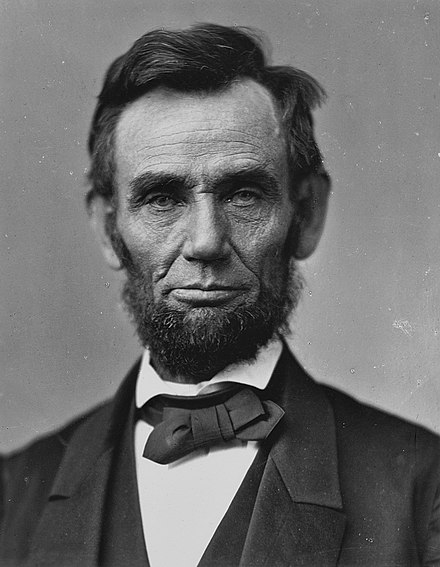
These quotes are taken from chapter 21 of Sheen’s The Church, Communism and Democracy.
No man is born great; if he does not become great through the reconciliation of great forces in tension, he remains mediocre. Moses was not always meek: he once killed an Egyptian; John the Evangelist was not always loving: he once wanted the Lord to rain down fire from heaven on his enemies; Paul was not alway an Apostle; once he was a persecutor; Peter was not always loyal: he once cursed and denied that he knew his Master.
In 1846, Cartwright, a political opponent whom Lincoln had defeated fourteen years before, charged him with impiety and atheism. Lincoln refused to take any public notice of the charge and told all his associates to forgo any reference to it, contenting himself merely with an affirmation of his belief in God.
While he was President, there was talk of impeaching Lincoln. The Chicago Times in March, 1863, wrote: “The crimes committed by the Executive . . . have furnished ample grounds for his impeachment; and every true patriot will rejoice to learn that he has been brought to punishment.”
In New York, Samuel B. Morse, the inventor of the telegraph, wrote to a brother-in-law that “Lincoln is weak, illiterate, a president without brains.” Another newspaper called him “the baboon president,” “a low-bred obscene clown.” Mrs. Lincoln was even called a spy, and Lincoln had to go in sorrow before the Senate to deny the charges.
A French politician, who happened to be in America at the time, wrote: “You Americans do not appreciate Lincoln, at his proper value. No monarch in Europe could carry on such a colossal war in front while harassed by so many factions and faultfinders behind. On every side, I hear people begin to say that Lincoln will merit more than a biography – he will merit a history.”
Lincoln was accused of drawing his salary in gold while the soldiers received their pay in depreciated greenbacks. The truth was that Lincoln was paid by salary warrants which he often failed to cash for months. One day in June, 1864, he made out a list of all his personal property, pocketed everything at hand, walked over to the Treasury, and dumped it all on the desk of Mr. Chase, with a request that it be invested in government bonds.
When a friend gloated because one of Lincoln’s enemies was defeated in an election, Lincoln said: “You have more of a feeling of personal resentment than I; perhaps I have too little of it, but I never thought it paid. A man has not time to spend half his time in quarrels. If a man ceases to attack me I never remember the past against him.”
Speaking of slander later on, he said: “Neither let us be slandered from our duty by false accusations against us, nor frightened from it by menaces of destruction to the government, nor of dungeons to ourselves. Let us have faith that right makes might, and in that faith let us, to the end, dare to do our duty ask we understand it.”
On the other hand, with that sorrow there was an inner joy. By joy we do not mean gaiety, or bubbling good humor. Joy is not even pleasure. There is a world of difference between joy and pleasure. Pleasure is associated with the body: for instance, we feel pleasure after a good meal. Joy is of the heart, and it comes from a good conscience. Joy hears music on the inside even when discords are ringing outside. Pleasure depends on outward circumstances, for example, wealth, friends, and wine, and therefore it can be obliterated by the slightest toothache. Joy is independent of outward circumstances; it can be felt even in adversity and pain.
Pleasures vary with age. Some men, as they grow older, identify happiness with the acquisition of wealth; Confucius said that very often those who were lustful and impure in youth turn what is left of their passions in old age into a lust for security and wealth. But joy has no seasons; it is the never-failing inner peace at all ages, the joys of the old being one with the joys of a child. Pleasure also satiates, but there is no end to joy. Pleasures can turn to pain of disgust, but joy brings no revulsion. It may not show on the lips, but it is in the heart, and those who have no joy in their own hearts cannot even see it in the hearts of others.
Joy is born in adversity. Affliction does not check joy; it increases it when the affliction is accepted as coming from the Hand of God; otherwise, it embitters and hardens a soul. But, with trust, sorrow repairs past failings; it becomes a crucible that burns away the dross of sin. The greatest cross in life is to have none. A comfortable environment does not lighten the soul as suffering can.
A log sings only when on fire; Our Blessed Lord gave a long discourse on joy on the night He went out to His death; and that was also the only recorded time that He ever sang. When Paul and Barnabas were stoned and driven out of cities, the Scriptures say “they were filled with joy.” Paul and Silas sang while in prison. The Apostles rejoiced because they could suffer persecution for their Master’s sake. This inner joy which is so compatible with adversity manifested itself superficially in Lincoln in a kindly smile and his fondness for making a heavy situation light with an amusing anecdote.
But the real source of his inner joy was a good conscience and a growing sense of living and acting under Divine Providence. Early in life, this good conscience manifested itself. Lincoln, with some friends, made a trip down the Illinois to New Orleans. They wandered about the city, and saw gangs of slaves who had come from the Kentucky and Tennessee sugarcane and cotton plantations. They stood in an auction room where slaves were being sold and they saw woman and girls stripp ed to the waist; men were handling them as they might have handled animals, making them run around to see whether they were healthy or lame, and opening their mouths as they might have opened the mouths of horses to calculate their ages and conditions. The auctioneer was reciting their good points: how much work they could do and how well they could do it. Lincoln heard the bidding, and saw the women shrinking from the men who had bought them and who were looking upon them with lecherous eyes. He heard the wailing and weeping as husbands and wives were separated and children torn from mothers never to see them again; with his lips quivering and his soul on fire, Lincoln turned to John Hanks and said:
“John, if I get a chance to hit that institution, I’ll hit is hard, by the Eternal God.” It was only a backwoodsman, a wood chopper, a boatman, and nothing more, who said it; a man who had been in school less than a year lifted his right hand to heaven and took a solemn oath. From that time on, it was “Know you not that I must be about My Father’s business?”
In 1862, while talking with Congressman Wilson, from Iowa, Wilson remarked: “If we do not do right, I believe God will let us go our way to ruin. If we do right, I believe He will lead us safely through this wilderness.”
The President was deeply affected, and he said to him: “My faith is greater than yours; I also believe that He will compel us to do right, in order that He may do those things, not so much because we desire them, as that they accord with His plans of dealing with the nation in the midst of which He means to establish justice. . . I have felt His hand upon me in great trials and submitted to His guidance and I trust that as He shall further open the way, I will be ready to walk therein relying on His help and trusting in His Goodness and Wisdom.”
Lincoln then added, with some dejection, that sometimes it seems necessary that “we should be confronted with perils which threaten us with disaster in order that we may not get puffed up and forget Him Who has much work for us to do.”
It was said of him that he never complained of food, bed, or lodgings. A friend of his said that he never cared where he was put to sleep in a public house, whether it was in the attic or the basement. He also said that Lincoln never knew what he was eating, nor did he ever feel his own utter unworthiness so much as when he was in the presence of a hotel clerk or a waiter.
His office had a special file which was labeled “Assassination.” In it were 80 threatening letters. He used to tell how, after the election of 1860, he came home tired and exhausted, and lay down on a sofa which was opposite a large mirror. Looking in the mirror, he saw himself at full length, but his face had two distinct images, one superimposed on the other. Rather confused by what he saw, he arose and examined the mirror closely, but the illusion had vanished. When he lay down again, it reappeared plainer than before and he noticed that one face looked much paler than the other. He asked Mrs. Lincoln about it, and she told him that she believed that he would be elected for two terms, but that the pale face signified that he would not live through the second term.
In April, 1865, Lincoln told of another dream of “deadly import” and “amazingly real.” Mrs. Lincoln, noticing how solemn he was, asked what was worrying him. He said that, after the dream, he had taken the Bible, and opened it at the dream of Jacob; later, whenever he turned a page of the Scriptures, it always opened on a dream or a vision. With this introduction he told the story of the dream. He said that he had been waiting for a long time for for important dispatches from the front, that he had not been in bed long when he fell asleep. In the dream, he felt the deathlike stillness about him: “Then I heard subdued sobs as if a number of people were weeping. I thought I left my bed and wandered downstairs. There the silence was broken by the same pitiful sobbing; the mourners were invisible. I went from room to room; no living person was in sight, but the same mournful sounds of distress met me as I passed along. There was light in all the rooms; every object was familiar to me; but where were all the people who were grieving as if their hearts would break? I was puzzled and alarmed, what could be the meaning of all this? Determined to find the cause of the state of things so mysterious and so shocking, I went on until I arrived at the East room, which I entered. There I met with a sickening surprise. Before me was a catafalque in which rested a corpse wrapped in funeral vestments; around it were stationed soldiers who were acting as guards. There was a throng of people, some gazing mournfully upon the corpse, whose face was covered, others weeping pitifully. “Who’s dead in the White House,’ I demanded of one of the soldiers. ‘The President’ was his answer. ‘He was killed by an assassin.’ Then came a loud burst of grief from the crowd which awoke me from my dream.”
It is strange how joy reaches its peak sometimes in the midst of greatest trial and danger. It was Good Friday afternoon, the day that Christ the Son of God died to save men from the slavery of sin, and the President and Mrs. Lincoln were taking the ride described at the beginning of this chapter. When Lincoln said: “I never felt so happy in my life,” he was referring to his inner joy. At that point, Mrs. Lincoln said: “Remember, you felt that way the day our little Willie died.”
It was on Good Friday that it was said of Christ, “having joy set before Him, He endured the Cross.” What Lincoln had failed to confess with his lips, namely, the death of the God-man to release men from the slavery of sin, he would now confess by his own death. No man ever drinks deep of the cup of suffering until he has tasted deceit. That night, he was shot by an assassin. The murderer injured himself as he tripped on the American flag which decorated the Presidential box. Thus the climax of adversity came on the day of his greatest joy: “This is the happiest day of my life.”
An old adage has it that “a tree is easier to measure after it has fallen.” Death sets all things in perspective. The only true greatness is that which endures after life. And in this case the fallen tree seems to have grown larger and larger as the years have gone by. America has always had a great feast of Thanksgiving, on which we thank God for our blessings. But Lincoln gave us something just as necessary, but something which had gone from our national life—a day of Fasting. Whether wars be hot or cold, whether they be civil or cosmic or atomic, we must never forget the wisdom of Lincoln, when he questioned, not whether God was on our side, but whether we were on His.
“It is the duty of nations as well as of men to own their dependence upon the overruling power of God; to confess their sins and transgressions in humble sorrow, yet with assured hope that genuine repentance will lead to mercy and pardon; and to recognize the sublime truth announced in the Holy Scriptures and proven by all history, that these nations only are blessed.
“And inasmuch as we know that by His divine law nations, like individuals, are subjected to punishments and chastisements in this world, may we not justly fear that the awful calamity of civil war which now desolates the land may be but a punishment inflicted upon us for our presumptuous sins, to the needful end of our national reformation as a whole people? We have been recipients of the choicest bounties of heaven. We have been preserved these many years in peace and prosperity. We have grown in numbers, wealth, and power as no other nation has ever grown; but we have forgotten God. We have forgotten the gracious hand that preserved us in peace, and multiplied and enriched and strengthened us; and we have vainly imagined in the deceitfulness of our hearts, that all these blessings were produced by some superior virtue and wisdom of our own. Intoxicated with unbroken success, we have become too self-sufficient to feel the necessity of redeeming and preserving grace, too proud to pray to the God that made us. It behoves us then, to humble ourselves before the offended Power, to confess our national sins, and to pray for clemency and forgiveness.”
George Washington will always be the father of our country; but Lincoln must always be considered its savior.

 Interplanetary Dust