
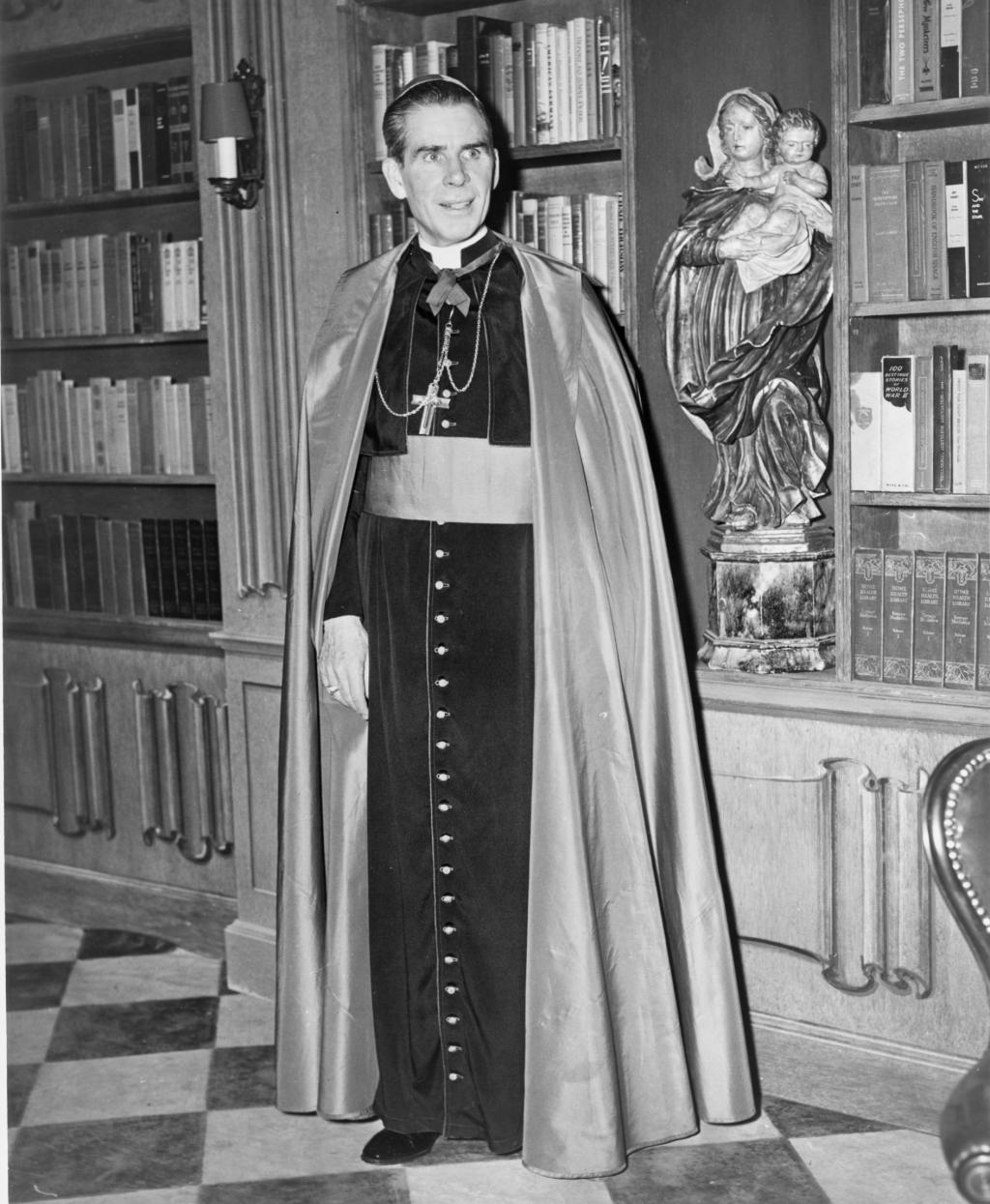
Address delivered on February 6, 1938.
By The Right Reverend Monsignor Fulton J. Sheen, Ph.D., LL.D.,
Agrege en Philosophie, University of Louvain, Belgium;
The Catholic University of America.
Last Sunday a very practical solution for our social ills was suggested, namely, the distribution of class struggle by the formation of professional groups or guilds made up of employers and employees, working together for the common good.
Today, developing the idea of Fraternity, Catholic social teaching offers the second practical solution of the social problem, namely Distribution. We begin with the fact which Communists, Socialists, Fascists, Jews, Protestants, and Catholics, admit in common; that is, the unequal distribution of wealth, its concentration in the hands of the few, and the impoverishment of the masses. There are only three possible ways to remedy this inequality: Firstly, continue Capitalism, in which the man who has nothing must work for the man who has everything; in which the worker is politically free but economically enslaved; and in which the problems of justice are settled by a display of force and civil war, with strikes as the weapon of one army and injunctions the weapon of the other. Or secondly, accept Communism, which cures the evil of unequal distribution of wealth by violently confiscating all productive private property, and by overthrowing the government and establishing in its place dictatorship of the proletariat, such as exists in Russia. Or thirdly, seek distribution of productive private property, which is the Catholic solution, now happily being recognized even by many non-Catholics. Capitalism believes in Possession; Communism believes in Confiscation; the Church believes in Distribution, or the union of popular freedom and economic freedom through widely distributed ownership. More simply, Capitalism stands for Possession through individual selfishness; Communism stands for Dispossession through collective selfishness; the Church stands for Distribution through Charity and Justice.
Apart too, from the disruption of society by violence and revolution, the break with tradition, the surrender of liberty to a dictator, Communism forgets that, as Aristotle said centuries ago, “that which is the business of everyone is the business of no one”. Under Communism the factory belongs to the workers in the same way the public parks belong to us. And yet how many Americans do you see going into the parks to pick up refuse on Monday morning, or mending a hole in the pavement? Production for profit such as exists in democratic countries can be made compatible with freedom and responsibility. Russia has proved that production for use cannot be made compatible with freedom, for when you get bureaucrats deciding how many pairs of trousers have to be made for the workers, you very soon reach the condition described by the Commissar of the Food Industry in Russia, Mikoyan, who said, “We are accustomed in the Soviet Republic to have goods of bad quality and always in insufficient quantities”1. Freedom leaves when everything, even food you eat, is planned for you by someone else. Anyone with ideas of his own is just as much a nuisance to a planned economy as to an army at war. When the dictatorship of the proletariat is set up, to whom do the proletariats dictate? And what happens if a worker holds an opinion contrary to the Dictator? The answer is: He is “liquidated” or “purged” or sometimes he just “disappears”. To dictate to a Dictator is the shortest cut to a tombstone.
Contrary to Communist propaganda, which tells us that the world must choose between Capitalism and Communism, the Church insists there is, a third choice and a golden mean, namely, the wider diffusion of private property, both productive and consumable.
But the Church looks beyond even the payment of a living wage. Here is hit upon the very essence of the Catholic solution. “In the present state of human society. . . We deem it advisable that the wage contract should, when possible, be modified somewhat by a contract of partnership. . . In this way wage earners are made sharers in some sort in the ownership, or the management, or the profits” of industry 2.
The argument the Church urges for a modification of the wage system by giving the proletariat some capital reveals a principle which the modern world has completely forgotten, namely that “hired labor” has “a social as well as a personal or individual aspect”3. It has an individual character because personally performed through moral duty or necessity. Labor has also a social character. This is particularly evident when a man hires himself out to labor for another. The social character of his labor is there revealed by the fact that he is part of an order in which “brains, capital, and labor combine together for common effort”4; his labor is social also because he is a member of society. Furthermore, the succession of his laboring days, the raising of a family for society, the education of children for the next generation, all constitute a social contribution.
Now what return does the worker receive for his labor? For his individual contribution the worker receives wages, with the twin fears of unemployment and insecurity. But what does he receive for his social contribution, his constantly increasing contribution to the common good and his constantly deteriorating physical strength? Presently, except in a few instances, he receives nothing. Wages recompense him for his hours by the clock, but they do not recompense him for the new wealth that is created by him in cooperation with “brains and capital.” That is where the suggestion of the Holy Father comes in: the worker should be entitled to some share in “the ownership, or the management, or the profits” of industry. In other words since he makes a social contribution he should also receive a social reward. The Church avoids the two extremes of Capitalism and Communism. Capitalism says the capitalist may “claim all the profits” while the worker has a right solely to his wage, which is often injustice to the worker. Communism, going to the opposite extreme, would say that the worker had the right to the whole product, which would be an injustice to the one who owned the capital. “Such men, vehemently incensed against the violation of justice by capitalists, go too far in vindicating the one right of which they are conscious”5.
The Church says neither class must be excluded from a share in the profits. “Wealth. . . must be so distributed amongst the various individuals and classes of society that the common good of all. . . be thereby promoted. . . [for] the vast differences between the few who hold excessive wealth and the many who live in destitution constitute a grave evil in modern society”6.
The next question is how and why should it be done? How will this be done? By violence? No! By confiscation? No! By educating the employer? Yes! By law? Yes! “The law should favor ownership and its policy should be to induce as many as possible to become owners”7. This is a call to give workers not only personal private consumable property, but even productive property.
Why should it be done? Because from a wider distribution of property three benefits would follow:
1) It would diminish class hatred and the “gulf between vast wealth and deep poverty will be bridged over, and the two [classes] will be brought nearer together”8 .
2) There will be “great abundance of the fruits of the earth. Men always work harder and more readily when they work on that which is their own. . . . Such a spirit of willing labor would add. . . to the wealth of the community”9.
3) It would make people more patriotic for “men would cling to the country in which they were born; for no one would exchange his country for a foreign land if his own afforded him the means of living a tolerable and happy life”10.
For the Catholic, then, the defense of the present system of Capitalism in which wealth is in the hands of a few is almost as wrong as the Communist solution which would destroy that wealth and expropriate it all into the hands of the Red Leaders. The Communists want to ‘break up’ Capitalism, by making the State capitalistic, and the workers proletarians or wage earners; the Church wants to ‘break down’ Capitalism by making the workers share “in the ownership, or the management, or the profits” of industry. The Communists want to concentrate; the Church wants to distribute.
The Church does not believe in putting all the eggs in one basket, but in giving a man a right to own a few eggs and, if he wants, to raise chickens and thus become a capitalist himself. By distributing a wide mass of property-owners throughout the country with their scattered powers, privileges, and responsibilities, one creates the greatest resistance in the world to tyranny, either political or economic, and also to foreign propaganda, either Fascist or Communist. Man likes liberty, likes to extend his personality by ownership, likes to call things his own, likes certain kinds of local affection, and these things the Church proposes to give him.
When the Church holds for a worker sharing in the wealth he produces, it does not propose mathematically equal distribution, but a sufficient distribution to give a tone and a spirit to society. Neither does the Church mean a return to small craftsmanship, for ownership of small things and distribution of ownership are not identical. At present time many a worker is not economically free because he lacks a possession to which he can give the imprint of his own will. To have his life ordered by others, who have no other authority than that they own the place where he works, is not freedom. That is why Capitalism will not do. Neither will a mere sharing the wealth in the hands of the State do, for what is the use of sharing the wealth unless you have something to say about it? It is not shared wealth workers want – for workers who receive wealth because the State sees that they do are slaves. If the State withdrawals its patronage they are left with nothing. There is very little difference between a worker losing his job because a Capitalist discharges him and a worker losing his job because a Commissar liquidates him – except that in the former case he still has his life. Self-government and responsibility, which are the attributes of freedom, are impossible when the Capitalists own all or when the Red Leaders own all.
In between these two extremes of Capitalism and Communism is a reconstructed order which secures the political and economic freedom of the worker. To the great credit of some modern industrialists these ideas of Leo XIII and Pius XI are already being put into practice, and the workers are being given some share in the profits they helped to create. The president of one corporation set up an irrevocable trust fund of $250,000 (one half of his personal fortune) invested in 7% cumulative stock of his company, the returns of which are to be paid to his workers, and this after increasing the salaries of 350 workers $85,000 a year. Another industrialist offered $1500 worth of stock to each of his employees, gave them the right to elect three directors to the corporation’s board of eight, and assured them that first dividends would be paid to employee stockholders.
There is a golden mean between selfishness and dispossession and that is sharing and distribution. Such is the Catholic solution, and it is one which will demand sacrifices which, up to the present, the majority of capitalists have been unprepared to make. Either big business in this country will share its profits with the workers as the Church asks, or it will be in danger of having its business confiscated by violent hands. There is no other course. Either they will give freely, or they will surrender involuntarily. Why should the employers monopolize for themselves tremendous reserves for depreciation, and give themselves vast bonuses, and yet make little or no provision for the social contribution of the employees who helped to create that wealth? “Social justice cannot be said to have been satisfied as long as workingmen are denied. . . the opportunity of acquiring a modest fortune and forestalling the plague of universal pauperism; as long as they cannot make suitable provision through public or private insurance for old age, for periods of illness and unemployment”11.
The Church is not opposed to Communism only because it is anti-religious and anti-God, or because it is violent, revolutionary, and disruptive of culture. The Church is opposed to Communism also because it enslaves the worker by keeping his body and soul chained to a Dictator: his body chained because the Dictator has all the jobs; his soul chained because he must think what the Dictator thinks. Furthermore the Church believes that one of the greatest obstacles in the way of effectively combating the evils of Communism is “the foolhardiness of those who neglect to remove or modify such conditions as exasperate the minds of the people, and so prepare the way for the overthrow and ruin of the social order”12. Remove the environment in which Communism grows and you do much to remove the menace of Communism. But if our great industrialists would sit down with their heads between their hands, read over these encyclicals of the Holy Father, and then announce their dividends not only on the financial pages of our newspapers, but also on the bulletin boards of their factories; if they would make their laborers “sharers. . . in the ownership, or the management, or the profits,” as the Encyclical asks, then they would need to worry less about the Reds. And the Communists know this; they admit that it is difficult for Communism to grow where business conditions are just. As their own official International Press Correspondence states: “the radicalization of the workers and their increasing impoverishment is the best soil for Communism” (Aug. 10, 1935). That means they want to see the workers kept in a lowly and unjust condition, for then they can incite them to violence. But share the wealth with the workers, help them to become OWNERS and sharers in the industry or factory or business where they work, and they will think twice before they follow the Communist cry for violence. They will see that they would not be destroying your property alone but theirs also. They will “sit down” on your machines, but they will not sit down on their own. Then the Communist will no longer be able to incite hatred against capitalists, for the workers will be capitalists themselves, that is, OWNERS of the productive capital which the Communists would seize. Then we shall see an industrial order in which 20,000 men will not say, for example, “we are working for such and such a corporation,” but “we are working with the corporation [as OWNERS].”
With this we come to the end of the triad: Liberty, Equality, and Fraternity. A social order cannot be constructed on liberty, understood as the absence of constraint, for this means in practice the right of the strong to devour the weak, as the evils of Capitalism have so well proved.
Neither can a social order be constructed on the basis of Equality, understood in the economic sense of the term, for this assumes that because men share wealth they are all equal. Thieves share the same loot, but they are not equal with those who do not steal. This false equality of Communism destroys freedom, because it identifies it with willing whatever the Dictator wills, and in the end creates a worse aristocracy than that of wealth, namely the aristocracy of “careerists” who ride to luxury on the wild horse of confiscation, violence, and privilege.
A true social order can be built only on the basis of Fraternity; namely, one inspired not by the profit-motive, which is Capitalism, not by the political-motive which is Fascism; not by the violence-motive which is Communism — but by the love-motive which is Christianity. Start with fraternity, which means that all men are brothers under the Fatherhood of God that all must function for the common good of society and for the peace of the world, and liberty and equality will follow. Liberty will follow, for the masses will then be free from economic want which will leave their souls free to seek that higher destiny to which they called, as heirs to the glorious liberty of the children of God 13. Equality will follow, for all men will be equal in the possession of the inalienable and sacred rights of human personality which no Dictator can take away, and equal also in their right to share the common heritage of civilization. Gone then will be that false equality of Communism which will tolerate no hierarchy, false because equality implies multiplicity in unity; gone will be that false liberty of Liberalism which is but another name for selfishness. In its place will come the equality which admits of differences and the organic relations of part to part for the proper functioning of the whole, and the real freedom which will be powerful enough to enforce freedom. Establish a society of that kind on the basis not of hate but of charity and men will salute one another on the streets not by the atomic name of ‘Comrade’ but by the Christian name of ‘Brother’.
[Transcribed and footnoted by Guy C. Stevenson, Sheen Project Manager ; Center for Economic and Social Justice – CESJ, June 19, 2014]
_________________________
1 (Statement made at the Plenary Session of the Central Committee of the Communist Party, Dec. 1935, Izvestia, Dec. 27, 1935; cf, Pravda, July 31, 1936)
2 Quadragesimo Anno §65.
3 Ibid.,§69.
4 Ibid.,§69.
6 Ibid.,§58.
7 Rerum Novarum §46.
8 Ibid.,§47.
9 Ibid.,§47.
10 Ibid.,§47.
11 Divini Redemptoris § 52. But social justice cannot be said to have been satisfied as long as workingmen are denied a salary that will enable them to secure proper sustenance for themselves and for their families; as long as they are denied the opportunity of acquiring a modest fortune and forestalling the plague of universal pauperism; as long as they cannot make suitable provision through public or private insurance for old age, for periods of illness and unemployment. In a word, to repeat what has been said in Our Encyclical Quadragesimo Anno.
12 Quadragesimo Anno §112.
13 [Dedication] Freedom Under God by Fulton J. Sheen, The Bruce Publishing Company, Milwaukee 1940.

 Interplanetary Dust