
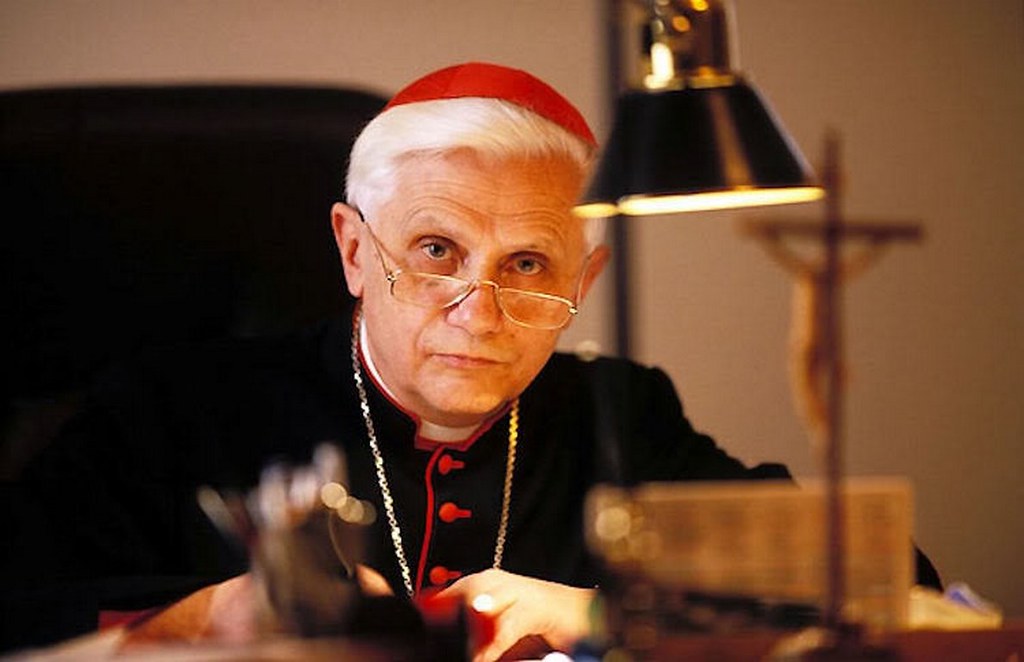
Homily for the Third Sunday in Ordinary Time (lectionary year A)
The reading we have just heard from Saint Paul’s First Letter to the Corinthians is almost disconcertingly up-to-date. Paul is speaking, of course, with the Corinthian community of the time and is trying to awaken its conscience to see all the ways in which it contradicts true Christian existence. But we immediately realize that this reading is not only about the problems of a Christian community of the distant past but that what Paul wrote then captures our own situation here and now. As he speaks to the Corinthians, Paul is speaking to us, and he puts his finger on the wounds of our life as Church today. Like the Corinthians, we too run the risk of fragmenting the Church into a factional strife in which every contestant develops his own idea of Christianity. In this way the rightness of one’s own position becomes more important than God’s claim on us, than being right before him. Our own idea conceals from us the word of the living God, and the Church disappears behind the parties that grow out of our personal opinion. The similarity between the situation of the Corinthians and ours cannot be missed. But Paul does not intend simply to describe a situation: rather, he speaks to us in order to rouse our conscience and to guide us back to the true totality and unity of Christian existence.
We must ask him, then: Just what is it that is false about our attitude? What must we do in order to become, not the party of Paul or of Apollo or of Cephas or even a party of Christ, but the Church of Jesus Christ? What is the difference between a party of Christ and his living Church? Between a party of Cephas and the right fidelity to the rock upon which the house of the Lord is built?
Accordingly, let us first attempt to understand what is actually taking place in Corinth and which constantly threatens to repeat itself anew in history because of the ever-recurring temptations to which man is exposed. We could perhaps briefly sum up the distinction that is meant here in the following statement: When I advocate a party, it thereby becomes becomes my party, whereas the Church of Jesus Christ is never my Church but always his Church. Indeed, the essence of conversion lies precisely in the fact that I cease to pursue a party of my own that safeguards my interests and conforms to my taste but that I put myself in his hands and become his, a member of his Body, the Church.
Let us try to elucidate this point in somewhat greater detail still. The Corinthians see in Christianity an interesting religious theory that answers to their taste and their expectations. They choose what suits them,; and they select it in the form that pleases them. But when one’s own will and desire is the decisive criterion, schism is a foregone conclusion, because there are multiple and opposing varieties of taste. A club, a circle of friends, a party can grow from such and ideological choice, but not a Church that overcomes antitheses between men and unites them in the peace of God. The principle by which a club develops is personal taste; but the principle on which the Church is based is obedience to the call of the Lord as we see it in the Gospel: “He called them, and immediately they left the boat and their father and followed Jesus” (Mt 4:21f.).
This brings us to the crucial point. Faith is not the selection of a program that is to my liking or the joining of a club of friends in which I feel understood but is a conversion that transforms me and my taste along with it, or at least makes my taste and my wishers take second place. Faith penetrates to an entirely different depth than change be attained by a choice that pledges me to a party. Its power to change is so far-reaching that Scripture designates it as a new birth (cf. I Pet I:3, 23)…
…There is a great danger today that the Church will disintegrate into religious parties that rally around individual teachers or preachers. And if this is so, what was true then is true once more: I am Apollo’s, I am Paul’s, I am Cephas’, and we end by making even Christ into a party. The norm of priestly ministry is the selflessness that submits itself to the measure of Jesus’ word: “My doctrine is not mine” (Jn 7:16). Only when we can say this in all truth are we “coworkers of God” who plant and water and thus become partakers of his own work. When men appeal to us and oppose our Christianity to that of others, this must always be a motive for us to examine our conscience. We proclaim, not ourselves, but him. This requires our humility, the cross of discipleship. But it is precisely this that frees us, that enriches and enlarges our ministry. For when we proclaim ourselves, we remain in our miserable “I” and draw others in to share our billet. When we preach him, we become “coworkers of God” (1 Cor 3:9), and what could be more magnificent and more liberating than that?
Let us ask the Lord to give us a renewed perception of the joy of this mission. When he does, the word of the prophet will once again prove true in our midst as well. This is the word that is always fulfilled when Christ walks among the nations: The people who live in darkness have seen a great light. . . . We rejoice in your nearness, just as they rejoice at the harvest, as they shout for joy when they divide the spoils (Is 9:1-2; cf Mt 4:16). Amen.
-Joseph Cardinal Ratzinger, Called to Communion: Understanging the Church Today pp. 157-165
The full text of the homily can be found here.
Below is the reading the homily was written for.
Second Reading: First Epistle to the Corinthians 1:10-13, 17
I appeal to you, brethren, by the name of our Lord Jesus Christ, that all of you agree and that there be no dissensions among you, but that you be united in the same mind and the same judgment. For it has been reported to me by Chloe’s people that there is quarreling among you, my brethren. What I mean is that each one of you says, “I belong to Paul,” or “I belong to Apol’los,” or “I belong to Cephas,” or “I belong to Christ.” Is Christ divided? Was Paul crucified for you? Or were you baptized in the name of Paul? For Christ did not send me to baptize but to preach the gospel, and not with eloquent wisdom, lest the cross of Christ be emptied of its power.
This was used under The Copyright Act’s Fair Use disclaimer found in section 107.

 Interplanetary Dust