
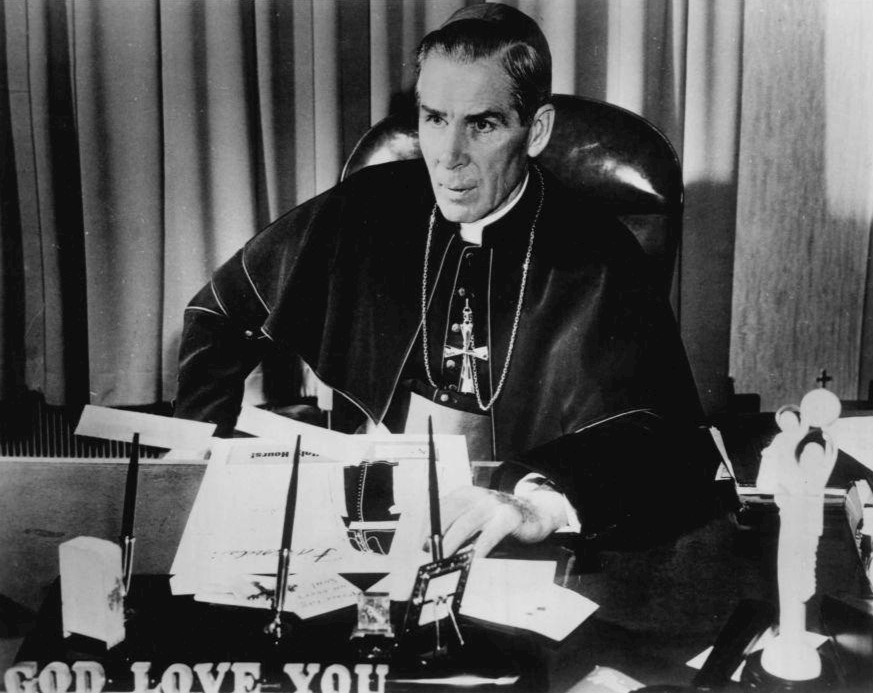
by Fulton J. Sheen
Address delivered March 23, 1941
“Everyone has his pet aversions. Mine are the use of words or slogans as substitutes for thinking, and among all such words and slogans, none is more thoughtlessly used in our day than “Liberal” and “Reactionary”. Those who use their tongues independently of their brains tell us we must be one or the other. It is the purpose of this broadcast to indicate that one can be and ought to be something else besides a reactionary or a liberal. What that is we shall say later on.
But presently, let us inquire how these two words arose: These epithets come into prominence whenever wars, revolutions, or depressions disturb an established order. They are born of rapid changes in the tempo of political economic, or social life. Now change implies two elements: First something which changes and, second, something which does not change; in other words something mutable and something immutable. For example, when meeting a friend whom you have not seen for twenty years, you say, “How you have changed.” If this person were not the same person now as twenty years ago you would not know he had changed. In other words, you cannot recognize change without the changeless.
Now the reactionary and the liberal have this in common: They never see permanence and change together. They take one to the exclusion of the other. The reactionary seizes upon permanency to the exclusion of change, and the liberal upon change to the exclusion of permanency. Both are extremists, and because they are extremists they are wrong. The reactionary wants things to remain as they are: the liberal wants change though he is little concerned with its direction. The word liberal is derived from “liber” the ancient god of wine, and hence the term originally and obviously implied intoxication. Shakespeare evidently had that in mind when he wrote in Henry VIII, “When you are a liberal, be sure you are not loose.” The reactionary has rather correctly been defined as a man who has two feet and new shoes but does not know how to walk; and a liberal as one who has both feet firmly planted in mid-air.
The reactionary believes that change in the present order is revolution; the liberal believes that change demands the repudiation of sacred and inviolable principles. The reactionary says: “Johnnie wears a green hat now; Johnnie will wear a green hat in the summer, spring, autumn and winter; when he is fourteen and when he is forty; he will wear it to breakfast, dinner and supper”. The liberal says: “No, style and conditions have so changed, give Johnnie a new head.” The reactionary wants the clock, but no time; the liberal wants the time, but no clock. The reactionary believes in staying where he is, though he never inquires whether he has a right to be there; the liberal, on the contrary, never knows where he is going, he is only sure he is on his way. The reactionary, instead of working towards an ideal, changes the ideal constantly and calls it progress.
There is a golden mean between the reactionary and the liberal, and the word that seems to fit best is ‘Catholic’. It avoids the reactionary position which would make Johnnie always wear a green hat, and the liberal position which would give Johnnie a new head, by letting Johnnie keep his head but giving him a new hat. It admits change without sacrificing the permanent and valuable. Because a social order needs changing the Catholic no more advocates the scrapping of the abiding principles of traditional morality than he advocates cutting an arm to fit a sleeve. Just as the cells in a human body change about every seven years and yet man remains identically the same person at seventy that he was at seven, so too, the Church contends, one can reconcile permanence with change without choosing permanence without change, or change without permanence.
The Catholic position can best be described in the scene of its foundation. One day our Blessed Lord entered into that ancient City of Caesarea Philippi, where He asked the most important question in the world: “Whom do men say that I am?” When men gave contradictory answers and the apostles gave none, one man, Peter, speaking in the name of all and with Divine illumination, answered: “Thou art Christ, the son of the Living God.” In answer to this, the Divine Saviour made Peter, as his name implied, the rock of His Church and gave him the power of keys: “Thou art Peter; and upon this rock I will build my Church, and the gates of hell shall not prevail against it. And I will give to thee the keys of the kingdom of heaven.” (Matthew 16:8, 19).
In founding His Church Our Lord combined two elements: The immutable and the mutable, the permanent and the changing. The Church would be immutable in her Truth–no other doctrine would ever be given it, not even by the angels; not a single iota of it would ever be changed; it would be as immutable as Divinity, as intolerant as the multiplication table, as absolute as its Giver. But that truth would need to be applied to different times and different circumstances. Since it was to last unto the consummation of the world, it would need a different emphasis for the twelfth century than for the first, and a different one for the twentieth than for the sixteenth. There would have to be something mutable in that immutable edifice. The immutable, changeless character was signified by the Rock; the mutable, changing character was signified by the keys. Truth, morality, and justice would be unshakeable like the Rock enduring to the crack of doom; but the truth, morality, and justice would have to be applied to different social, economic, and political conditions, for the civilization of the fifth century would not be the same as the thirteenth, nor the thirteenth the same as the nineteenth. Hence, Our Lord said, in effect to Peter: For what is right and good in social and economic progress you may open the door; but for what is wrong and false you close the door. Hence, I give you the power of the keys: “Whatsoever thou shalt bind upon earth it shall be bound also in heaven; and whatsoever thou shalt loose upon earth, it shall be loosed also in heaven.” (Matthew 16:19). This use of the words rock and key by Our Divine Lord gives the answer to that group of so-called Liberal writers who recently proclaimed: “The absoluteness of the Church is inconsistent with the relativity of history” (City of Man–page 40). This is just like saying the absoluteness of the multiplication table is inconsistent with the relativities of history, for now we no longer count pyramids but skyscrapers.
A Catholic is neither a reactionary nor a liberal in the sense of the terms above defined. He is not a reactionary because the Catholic knows that if you leave things alone you will not leave them as the are. If you leave a corn field alone, you do not have corn but weeds; if you leave a white fence alone you soon have a black fence. So too the Catholic says: If you leave men alone without vigilance and discipline, you have either a rusted man or a rotted man, for man decays more rapidly than he evolves, as modern history so well demonstrates.
Neither will the Catholic be a liberal who wants to make progress by scraping eternal principles and ideals. The Catholic argues that unless you have a fixed point of departure and a fixed goal, you never know you are making any progress. How can an artist know he is making progress in painting, if every time he looks up from the canvas he finds a different person sitting for his portrait?
The terms reactionary and liberal are so relative they mean little to the thinking men who have either knowledge of history or a remnant of reason.
For example, the liberal of the last generation invoked liberalism to free economic activity from state control; the liberal of today invokes liberalism to extend state control over the economic order. The old liberal was a defender of Capitalism; the new liberal is reacting against Capitalism and wants some form of collectivism or state control. The old liberal wanted liberty of press, speech, and conscience within the framework of democracy; the new liberal, reacting against the old liberalism, wants the liberty without the framework as its safeguard. The old liberal rebelled against taxation without responsibility; the new liberal wants the taxation as a handout without responsibility. The old liberal fifty years ago was materialistic in science. His son who calls himself a liberal is today’s reactionary for whom science is idealist. The French Liberals who protested against the authority of King and Altar in the name of Liberty, were reactionaries, for they did not believe in extending that liberty to the proletariat. Many liberals who wrote they believed in the equality of all men, kept slaves. To change it around, every reactionary is protesting against the last liberal. Sometimes in one man the liberal and the reactionary meet, as they did in the case of Milton. Milton was a liberal who favoured a free press and protested against licensing of books; and when a handsome salary was offered him he reacted against his liberalism and became an official censor of books.
All that we have in the world is reaction against reactions; revolt against revolts. The reactionary and liberal are on a see-saw, and think they are going places because they are going up and down and see their momentary triumph over their opponent.
In the strict sense of the term, there are no liberals. A liberal is only a reactionary, reacting against the last form of liberalism. The new liberals are at war against the old liberals; the new rebels in rebellion against the old rebels. The liberal of today will be the reactionary of tomorrow. This simple analogy will help to make clear how our so-called liberalism is only a reaction against the last liberalism. A woman buys a new dress for a ball to be held say on April 14–notice it is put at the end of Lent. This dress is the last word in style; in political language it is ‘liberal’, ‘progressive’, far ahead of the reactionaries who bought their dresses last year. At the ball, jealous and envious eyes are cast upon her, and to her face, the most flattering of compliments. Even the word “daring” is used.
Now it happens that she is invited to another ball, one month later and with the same group of people, and in the same place. Would that woman wear the same gown? She would not. She would rather die first! Why would she not wear it? Because people had seen it before. She would no longer be liberal. She must have a new gown for the new ball. In order to be a liberal in May, she has to be a reactionary against her liberal gown of April. That is why I say every liberal is reactionary.
The Church believes it is possible to make a distinction between being fashionable and being well dressed. Consider, for example, the vestments worn by the priest at the altar. They certainly are not fashionable, for they are really an adaptation of the old Roman toga; but though you never see a chasuble in a fashion magazine, who would deny that the priest at the altar is becomingly and beautifully clothed. The ideas of the Church are like her vestments; always well dressed but never the slave of passing fashion.
The Church knows after 1900 years’ experience that any institution which suits the spirit of any age will be a widow in the next one. The Church, therefore, will never please either the reactionary or the liberal. She will please only the relatively few who can understand how a house built on an immutable rock with an abiding proprietor, Peter, has a key that admits strangers. The reactionaries want the rock without the keys; the liberals want the keys without the rock; and we who believe in Christ, who gave both to Peter, want both.
May I in conclusion plead with you to sweep away slogans that mean nothing and begin to be among the thinking elite who want to build a very different and happier world than the one we live in now. You have been told that the only choice possible is to be a reactionary or a liberal; that you must go either right or left. That would be true if you lived on a two-dimensional plane and this world were all; but you have a soul as well as a body. You need therefore a three dimensional universe, one with height where you can stretch not your necks but your hearts. A mule can travel only in two directions; either right or left. He must be either a reactionary or a liberal. But because you have a soul there is another direction open to you, namely toward God for whom you were made. Let the unthinking squabble about what a grandson ought to believe, or what a grandfather did believe, but concentrate on what a godson believes because born of the Spirit. If you are honest with yourself you will admit that you are weary of religions, politics, and panaceas that flatter the way you live; you want something that will contradict the way you live and therefore be capable of redeeming you; you are sick of revolutions that only change booty and loot from one man’s pocket into another’s; you want a revolution that will change your hearts. Leave it to the comedians to talk about “progress” when humanity is preying upon itself, for what they call progress is only a process–the fashion of the world passing away.
Put behind you the acceptance of nonsense because you dislike holding something with ethical consequences. Realize that you must be saved not for these days, but from them; that a new order may begin whenever you can live as created in time but ordered for eternity. Do you not see that where Christ is persecuted in the world today, man is most defeated?
You are weary of the see-saw of reactionaries and liberals; you want a force and a spiritual power that will be hated by both, as Our Divine Lord was hated and considered a menance by the reactionary Pharisees and a disturbing factor by the liberal Herodians. You want today a force that will rescue you from the evil in the world and still let you do good in the world; which unlike the world will not tell you to go right or left, but up: “And I, if I be lifted up from the earth, will draw all things to myself” (John 12:32).
That is what you want: I do not know whether you have found it. Would it interest you to know that I have? I have found it in the heart of Christendom, in the crystallization of common sense, in the living memory of the centuries, in the Church built upon a Rock and governed by the Man with Keys. I have found it in that which is hated as much as Christ was hated, misunderstood and maligned as much as He was maligned, but loved as much as He was loved. I have found it in an institution which millions who are not its members recognize as the only moral authority left in the world. I find it in the prolonged Christ whom the reactionaries find too liberal and the liberals find too reactionary; something that challenges the world, not pampers it; which speaks a truth that because it is God-made cannot be man-remade; which restores me to the Saviour’s embrace when I sin; which nourishes my soul with the life of Christ when I hunger; which leads me to Calvary when I become undisciplined; which thrusts before me a Cross to inspire service of others to sacrifice; which tells me what is right when the world is wrong; and which will minister to my soul when my lease on life is ended. In a word, I am neither a Reactionary nor a Liberal–I am a Catholic.

 Interplanetary Dust